

Guide
Fixing feng shui without demolition
Deal with feng shui issues at low cost, with little disruption and in the right order — before anyone thinks about knocking down walls or rebuilding.
What you need
- An as-built plan that matches reality, with polarity set to the facing degree.
- The feng shui check result: the list of issues and where each one is on the plan.
- The family's birth years, to know whose birth-year mountain each issue affects.
- A list of what cannot move: columns, beams, drain pipes, septic tank.
Steps
- Sort the issues
Split issues into three groups: furniture (bed, stove, altar, desk), room use (bedroom, kitchen or bathroom in a weaker sector) and structure (main door, fixed bathroom or kitchen block). Fix them in that order, from light to heavy.
- Move and turn furniture
Put the bed head against a solid wall in a favourable sector, turn the stove to a solid wall, and move the desk so you sit with solid backing. These are light fixes, usually done in an afternoon.
- Swap room uses
Two rooms of similar size can swap: the bedroom moves to a favourable sector, storage or a spare room to a weaker one. Making a bathroom more compact can also give the centre of the house back.
- Break the alignment
If the main door, stove and bathroom door sit on one straight axis, separate them with a half-height partition, shelving or a screen, or shift a door off the axis. Doors that only see each other at an angle are usually fine.
- Reposition the altar
The altar needs a solid, steady wall behind it — not a bathroom, kitchen, window or walkway — and is read together with the house's sitting and facing. Moving it to another wall of the same room is often enough.
- Decide: keep the layout or re-arrange
If serious issues remain at the main door or a fixed bathroom or kitchen block, weigh it up: keep the layout and accept small remaining issues, or re-arrange the interior within the same building outline. Compare the building cost with the issues it resolves.
- Check again after every fix
After every move or swap, run the feng shui check on the plan again to be sure the issue is gone and no new one has appeared.
Common mistakes
- Knocking out the main door or a wall when moving furniture would solve it.
- Moving the toilet, basin or shower into a corridor or walkway to get the “right sector” — moving a bathroom means moving the whole room, with walls, door and drainage.
- Turning the bed head to a good sector but under a window or against a bathroom wall.
- Fixing one issue without checking again and creating another — for example a new stove position facing the bathroom door.
- Re-arranging the whole house when just one or two light issues remain.
Do it in Home Check
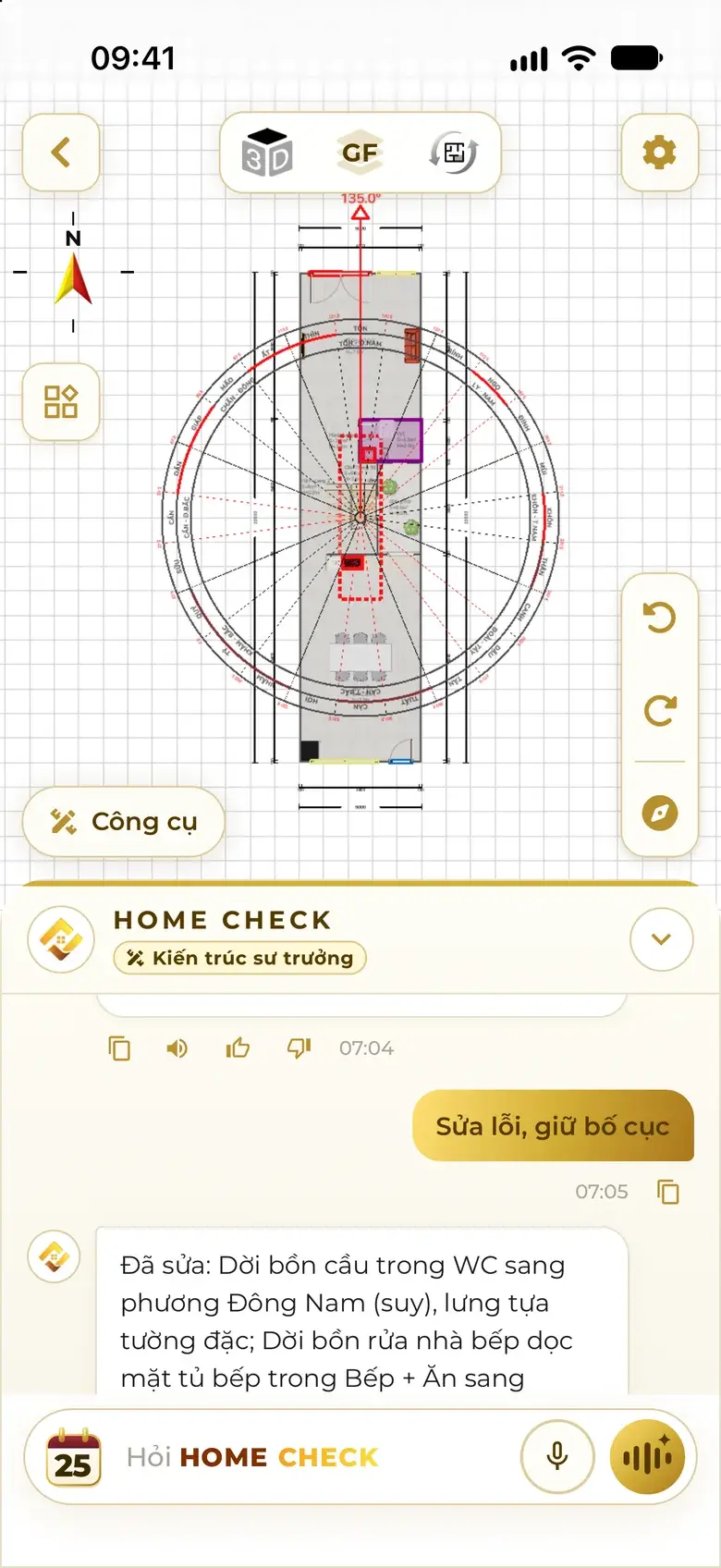
- On a plan that has been checked, tap “Assistant” and say “Fix the feng shui faults”, or tap the Fix button under the issue card.
- The assistant always asks how to fix first. Keep the layout: stairs, outer walls and main door stay; you pick what to fix — kitchen, bathroom, main door or all — and the assistant moves, turns and re-assigns until the issues are gone, explaining any that remain.
- Thorough fix: the outline, number of floors, rooms and facing stay; the interior is re-arranged into up to 3 options with before-and-after scores, and your current plan is untouched until you pick one.
- Moving a bathroom means moving the whole room; if there is no valid place, the assistant does not move it and suggests another way. Every change can be undone.
Questions
Which issues can be fixed by moving furniture?
Bed head, stove direction, altar and desk positions, and bathroom fittings within the bathroom itself — most can be fixed by moving or turning things without touching the walls.
When should I re-arrange the layout?
When serious issues sit in fixed blocks: a bathroom or kitchen in the centre palace, or a main door with an issue that cannot be moved. Then re-arranging the interior within the same outline usually beats patching spot by spot.
Will the fixes spoil how the house works?
Every suggestion from the assistant must pass both feng shui and architectural standards: no bathroom fittings in walkways, no blocked doors, enough room to move around. Every change can be undone.
How do I break a door – kitchen – bathroom alignment?
Shifting a door off the axis, or adding a half-height partition, shelving or a screen between the two doors, are common ways. After the change, check again on the plan to be sure the axis is broken.
How are tokens charged for fixing feng shui in the app?
Pay for what you use: check, analysis, fix — each uses tokens for that task only, and only after you have the result.
Do this for your own home in the app
Scan with your phone to get Home Check.
You are viewing this page inside another app. Tap ⋯ and choose “Open in browser” to get the app.
Markdown version of this page Index for machine readers (llms.txt)